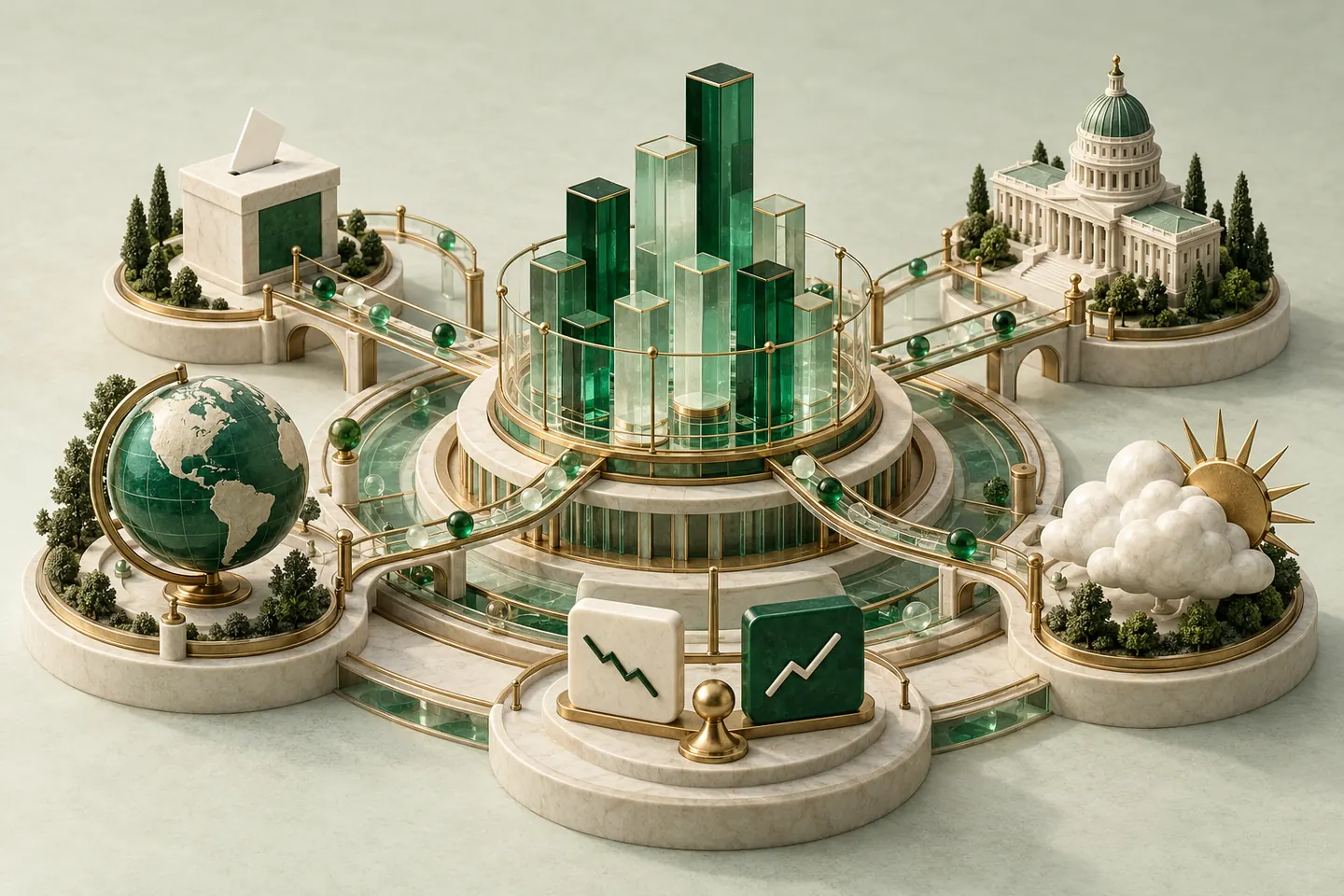
From forecasting experiments to public markets
Real money prediction markets began as forecasting experiments and have grown into markets used around the world. Traders buy and sell contracts on events such as elections, economic reports, climate changes, and entertainment awards. Each price brings together information from people who stand to gain or lose money on the outcome.
When you trade on a prediction market, you contribute to a shared forecast. People act on the information they have, and their trades help set the price. For more educational material, see PredStack’s prediction market guides.
How prediction markets differ from polls
Polls capture sentiment at a particular moment. Their results can be affected by who responds and whether people give answers they think are socially acceptable. Market prices change as people trade on new information:
- Traders gain or lose money depending on whether their predictions are right.
- Prices respond as traders act on new information.
- Trades can bring private information and specialist knowledge into the price.
- Expressing a belief through a trade means putting money behind it.
The parts of a prediction market
| Component | Function |
|---|---|
| Market question | A question with two or more possible outcomes, such as "Will the Fed cut rates in June?" |
| Contract | A tradable asset that usually pays $1 if its outcome occurs and $0 if it doesn't. |
| Price | For a contract that pays $1, a price of $0.65 implies roughly a 65% chance before fees. This is a market estimate, not a guaranteed probability. |
| Liquidity providers | Place buy and sell orders so other traders can enter or leave a position. |
A headline may leave out details that matter under a contract's settlement rules. Before buying, read those rules and compare the price with your own estimate of the outcome's probability. Check whether there are enough buy and sell orders to make your trade.
What market prices can tell you
Forecasts of political changes and economic downturns can inform decisions involving large sums of money. Platforms such as Polymarket and Kalshi make event trading available to individual traders. Blockchain records and regulatory oversight are different approaches to transparency and protection against manipulation.
What to check before you trade
Read how the contract will be settled and which sources will determine the result. The wording should be clear enough to avoid competing interpretations after the event. Look at trading volume too, since a thin market can mean paying more than you expected.
An event's probability and a trade's expected value are different questions. Before trading on politics, economics, or technology, be clear about why you think the price is wrong, what data supports your view, and how much you are prepared to lose.
Frequently asked questions
Market topics
- 2026 midterm elections
- Global GDP growth rate
- AI model release dates
- Year of a SpaceX Mars landing
Reading market forecasts
A market price is an estimate, not a guarantee. Thin trading, fees, and unclear settlement rules can affect how useful that estimate is. This site explains the mechanics and risks; examples illustrate how contracts work.